Showing posts with label sports betting. Show all posts

Wednesday, May 9, 2018

The NBA's "Integrity Fee" Is Ridiculous, But Not Unprecedented (Pt II)


Sports betting has always been highly stigmatized in this country. Hence, when faced with the Pete Rose scandal in the early 90s, most Americans favored a decision that led to more criminalization and prohibition. Consequently, the Professional and Amateur Sports Protection Act (PASPA), which banned the expansion of legal sports betting, was passed in 1992 in a widely bipartisan manner.


On the other hand, sports gambling scandals tend to elicit pleas for more transparency in Europe where most of the market is legal and regulated. That’s exactly what happened in the wake of a €2 million match-fixing scandal in 2005. The German professional soccer league Bundesliga was rocked by revelations that a referee, Robert Hoyzer, had been fixing matches.


That scandal indirectly led to the formation of ESSA (Sports Betting Integrity). This independent organization is funded by 26 legal bookmakers in the European Union. The bookmakers that are members of ESSA share information about suspicious betting information. 


Those companies spend a tremendous amount of money on staffing and software to monitor suspicious betting. As a result, when suspicious behavior is discovered, ESSA files reports that are distributed to the proper gaming regulators. ESSA communicates with 20 of the top sports governing bodies, including FIFA and the IOC. 


Most Americans are completely unaware of ESSA’s existence. That’s most likely why the NBA has been able to lobby for its “Integrity Fee.” To be brief, ESSA (a non-profit organization) has been expertly monitoring suspicious betting for several years and it has done it with only a sliver of the budget demanded by the NBA.
 

With that said, the NBA isn’t the first sports league to lobby for an Integrity Fee. In 2010, the French legislature required bookmakers to pay fees to the respective sports leagues. As a result of that fee and other burdensome taxes, there aren’t many licensed sportsbook operators in France, sixteen to be exact. Thus, roughly 40% of France’s sports betting takes place in the black market.
 

A few other countries have imposed these types of fees as well and the Asser Institute conducted the most comprehensive study on this issue. That study didn’t find these fees to be necessary. Instead, it determined that “integrity benefits…could be achieved well outside the framework of private law.” It also came to the logical conclusion that overtaxing the sports betting industry forces much of the activity into the black market.

By the same token, ESSA has found that sports betting is very likely to take place in the legal market as long the government’s taxes don’t surpass 20% of the sports betting revenue or “hold.” Khalid Ali, the Secretary General of ESSA, mentioned several positive models. However, the U.K. seemed to stand above the rest.


Bookmakers in the U.K. are taxed at 15% of the hold. As a result, there are over 200 licensed operators in the U.K. and, remarkably, only 5% of the betting is believed to occur in the black market.


A fully legalized market results in amazing transparency with twofold benefits. Europe’s bookmakers have to follow strong anti-money laundering laws, which help to deter game fixing. That data also helps to provide better investigative leads into suspicious betting.


To be precise, ESSA issued 266 alerts of suspicious wagering last year. These potential scandals involved eleven different sports and spanned every continent except Antarctica. Notably, seven of these alerts involved six tennis matches and one boxing match in the U.S.


Tennis is responsible for the highest percentage (60%) of alerts worldwide and there are a variety of reasons. To name one, it’s much easier to fix an individual sport. Also, these cases almost always occur in the circuits involving poorly-paid players. The second-most affected sport is soccer with 17% of the alerts. Again, these cases rarely involve the major sports leagues. After all, those players generally make way too much money to be corrupted in this manner.

Wikimedia Commons
Thankfully, transparency helps to identify potential game-fixing in these lower-level circuit games. There are obvious red flags, such as high levels of action on otherwise obscure games. However, this fully regulated environment allows bookmakers to attach advanced risk profiles to their clients that can trigger alerts from a variety of factors, such as geography, activity levels, etc.

All in all, it appears that PASPA will be overturned and there’s a lot of uncertainty in the U.S. for how to proceed with taxation and regulation. However, the international community offers many lessons for the proper guidelines.


The black market can be practically eliminated as long as the taxes are reasonable. That will create substantial transparency and drastically improve sports integrity. Also, there’s no need to impose an Integrity Fee on behalf of the sports leagues. Those efforts can accomplished for a fraction of the price and most of the costs are already absorbed by the bookmakers.

Monday, May 7, 2018

The NBA's "Integrity Fee" is Ridiculous, But Not Unprecedented (Pt I)


In the near future, it’s likely that the U.S. Supreme Court will overturn the Professional and Amateur Sports Protection Act (PASPA). States will then have the right to legalize sports betting within their borders.

In fact, several states have already begun drafting proposals in advance of the Supreme Court’s decision. However, the NBA’s proposed “Integrity Fee” will probably be the main obstacle towards progress with legalization and regulation.

Indiana was the first state to draft a bill that would give 1% of every bet in their state to each respective sports league. This idea came from the NBA and MLB with the argument that an expanded legal sports gambling market will increase their costs associated with monitoring that activity. 

In fairness, the sports leagues will need to spend more money on gambling-related staffing if more states legalize sports betting. However, those costs will be minimal in comparison to the profits generated from increased interest as result of legalized gambling. After all, Adam Silver has openly acknowledged that legalization will definitely benefit his industry.

Simply put, the NBA’s lobbying demands are outrageous. The sports leagues don’t charge licensing fees for accepting wagers on their games. Therefore, there’s no reason to believe that the sports leagues have any legal leverage to negotiate for an Integrity Fee.

Also, a 1% fee may sound inconsequential because many people assume that it’s based on a sportsbook’s revenues or “hold.” Instead, the fee would be based on the total dollar amount of accepted wagers, i.e. a sportsbook’s “handle.”

Sportsbooks have a statistical advantage over the bettors, but the house is not guaranteed a profit. Sports gambling is a low-profit industry. Over the last 23 years, Nevada casinos have earned a “hold” of 4.78%. That hold percentage seems to be declining as bettors are becoming more educated about the industry. Regardless, a 1% Integrity Fee would take roughly 21% of the casinos’ sports betting revenues. 

Jay Kornegay, the Director of the Westgate Las Vegas SuperBook, points out that the Integrity Fee doesn’t include the federal excise tax of 0.25% on the handle or Nevada’s 6.75% tax on the hold. Kornegay also estimates that the sportsbook’s operating costs take away roughly 60% of the revenue. Furthermore, the gaming taxes in Nevada are much lower than several other states.  
  
Needless to say, if states pass sport gambling bills that include this Integrity Fee, it will be highly counterproductive. To compensate for the cost, legal sportsbooks may need to charge a higher “vig” or commission than illegal bookmakers. Also, those costs will deter many reputable casino operators from offering sports wagering. Therefore, only a small percentage of the existing black market will shift into the legal/regulated market.

Although the NBA and MLB are presenting this as a “fee,” this is essentially a tax that benefits private companies; it’s the perfect example of crony capitalism. Our country can learn lessons by reviewing its history with over-taxing the gambling industry. In 1951, Congress placed an excise tax of 10% on every sports wager. This was a recommendation from the Kefauver Committee that investigated organized crime.

At that time, the most popular sport for gambling was horse racing, which has a higher profit margin for the sportsbook than most traditional sports. Nonetheless, the 10% excise tax killed the legal betting market.  

However, the demand for sports betting remained undeterred. Nevada hosted several sports-betting-only-facilities that were not operated by casinos. These “turf clubs” were unregulated and notorious for tax dodging. The Vegas bookmaking veteran, Jimmy Vaccaro, explained the simplicity of the scam in Art Manteris’ book, “Super Bookie.” Bookmakers and bettors often had handshake agreements to write betting tickets for small fractions of the actual wager.

Ultimately, this naïve recommendation from the Kefauver Committee resulted in a worst-case scenario. There was very little tax revenue for the government and far less transparency to root out corruption. (Decades later, Congress reduced the federal excise tax to the current 0.25% level, which is four times less than the proposed Integrity Fee from the sports leagues.)

All in all, there are many disturbing aspects to the Integrity Fee. Worst of all, it subtly negates the direct role that sportsbooks play in upholding the integrity of the game. The sports gambling industry has already absorbed the operating costs for upholding integrity. After all, a bookmaker has a vested interest to not accept bets from someone who is fixing games.

Sportsbooks are key allies to the sports leagues for detecting suspicious betting patterns. Case in point, the aforementioned Jimmy Vaccaro contacted the proper authorities in 1994 when he was the Director of the Mirage’s Sportsbook. He witnessed an unusual amount of money bet against Arizona State, among other red flags. In the end, Vaccaro’s information eventually led to criminal charges and discovery of a major point-shaving scandal.

Wikimedia Commons

That is only one of several examples in which bookmakers have acted as unofficial partners with the sports leagues. However, Nevada represents roughly 3% of the actual betting market in this country. In other words, there stands to be far more transparency for discovering more examples of point-shaving if PASPA is overturned, thus improving sports integrity. 

The question of how to properly regulate, tax, and ensure game integrity in an expanded sports betting industry represents uncharted waters in the United States. Thankfully, the international community provides several examples with blueprints for the future.


In fact, proper sports integrity regulation is conducted for only a small fraction of the price demanded by the NBA and that will be detailed fully in Part II.


Tuesday, December 5, 2017

New Jersey Likely Won First Round in Sports Betting Battle in US Supreme Court

Yesterday, the U.S. Supreme Court court heard the first oral arguments in Christie v NCAA. If you're not familiar with this case, New Jersey is trying to overturn the federal sports beeting ban, the Professional and Amateur Sports Protection Act of 1992 (PASPA). The law blocks states from legalizing sports gambling within their own borders. The state of New Jersey asserts that this is a violation of the 10th Amendment because four states, primarily Nevada, were grandfathered in and able to still offer legal sports betting in their states. (My latest article with The American Conservative has many interesting background details on the case.)

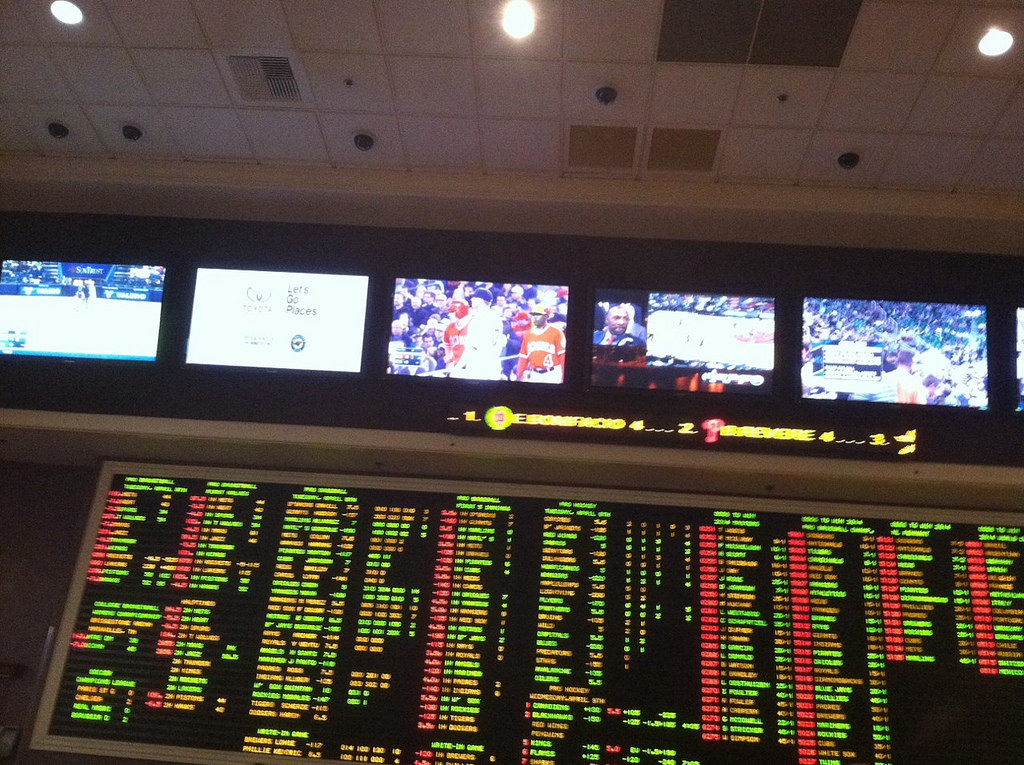
Las Vegas Sportsbooks such as this one may get some competition in the future, depending upon the outcome of Christie v NCAA. (Image via Wikimedia Commons)

Make no mistake, the federal ban on sports gambling could easily be overturned in a conservative Supreme Court (5 Republicans - 4 Democrats). The reason is that Christie v NCAA is a states' rights battle, not a gambling issue. And, generally, the conservative viewpoint supports states' rights.


The transcript shows that three of the liberal Justices (Ginsburg, Sotomayor, Kagan) began with an aggressive line of questioning for Theodore B. Olson who was arguing on behalf of New Jersey. (Olson served as the Solicitor General during the George W. Bush administration.) However, the left-of-center Justice Stephen Breyer seemed to show his leaning from the beginning. He seemed to be making Olson's case for him by, at one point, citing the Airline Deregulation Act. However, Breyer later pivoted and essentially pointed to other issues in favor of New Jersey's case.

U.S. Supreme Court Justice Stephen Breyer - Wikimedia Commons

As usual, Clarence Thomas didn't speak, but he's a strong advocate for states' rights. His four conservative counterparts seemingly signaled their support of New Jersey's case with their questioning. And, in the end, nearly every legal analyst believes at least five and maybe six Justices will vote to overturn PASPA. That includes sports law expert and media figure, Daniel Wallach, who believes that it is 6 to 3 in favor of New Jersey. Wallach believes that it will go according to party lines, other than Breyer who will rule in favor of New Jersey.

Likewise, in a more sports betting friendly format, Dustin Gouker of the Legal Sports Report set a fictional over/under on the number of Justices leaning in favor of New Jersey at 5.5.

So far, so good. We'll have to see how this proceeds. Hopefully, this senseless, crony capitalist federal sports betting ban will be overturned.


Tuesday, February 28, 2017

Legal Sports Betting May Happen Soon Due to Potential Trump Nominee

Miguel Estrada (a partner with a law firm that represented New Jersey's quest for legalized sports gambling) is reportedly a leading candidate to be the Solicitor General nominee.


New Jersey passed a statewide voter referendum to legalize sports betting in 2011. The sports leagues sued the state of New Jersey as their legislation violated a federal law that bans sports betting, the Professional and Amateur Sports Protection Act of 1992 (PASPA), in every state other than Nevada, Delaware, Montana, and Oregon. In response, the state of New Jersey appealed the constitutionality of this decision through the federal courts. Their attornies contested, to no avail, that PASPA violates the 10th Amendment.

New Jersey appealed this decision to the U.S. Supreme Court, which declined to take their case. However, the U.S. Supreme Court recently asked the Solicitor General to file a brief with more details. In other words, one or more of the justices seem to be interested in this case. Therefore, if the new U.S. Solicitor General believes that there is merit to New Jersey's appeal, then there is a good chance that the U.S. Supreme Court would hear their case. Hence, whoever is appointed as the next U.S. Solicitor General could have a major impact on the future of sports gambling.

Photo (Wikimedia Commons)

Chuck Cooper (a D.C.-based attorney with connections to Trump and Jeff Sessions) was reportedly the first choice of President Trump. However, Cooper has since withdrawn his name for consideration due to the negativity associated with the nomination process for Jeff Sessions.

According to law.com, Miguel Estrada is now the likely frontrunner for the job. He's an especially relevant name with this issue because he's a partner with Gibson, Dunn & Crutcher. That firm has received over $6 million to represent New Jersey's challenge against PASPA. In fact, Gibson, Dunn & Crutcher has been somewhat of a nemesis to the NFL. Their firm represented the NFL Players' Union during the players' strike of 2011 and an anti-trust civil suit of 2009. In addition, their firm issued this report that was critical of the Unlawful Internet Gambling Enforcement Act of 2006 (UIGEA) due to its burdens on financial institutions.

Estrada has yet to be named as the nominee, but he worked in the Office of the Solicitor General during the George W. Bush administration. With that said, like Chuck Cooper, Estrada may now be reluctant to go through the nomination process. Estrada was nominated in 2001 by George W. Bush for a seat on the U.S. Court of Appeals for the D.C. Circuit. He was aggressively filibustered by the Democrats because he was part of the infamous U.S. Supreme Court case, Bush v Gore, which decided the 2000 Presidential election. Ultimately, Estrada withdrew his name from consideration and he returned to Gibson, Dunn & Crutcher.

To sum up, the news of Miguel Estrada as the next potential U.S. Solicitor General is promising news if you're a supporter of legalized sports gambling. Maybe this issue will be finally legislated on a state by state basis.


Wednesday, December 28, 2016

Harry Reid opposes DFS; He Prefers NV's Monopoly on Sports Betting


Harry Reid (Photo/Wikimedia Commons)
Nevada Senator Harry Reid recently had an exit interview with the Las Vegas Review-Journal. As always, Reid was outspoken and he offered his thoughts on daily fantasy sports. He said, “(Daily) fantasy sports is the worst of the worst.”   


You may not be familiar with daily fantasy sports, but you likely know of the companies that dominate this industry, FanDuel and DraftKings. If not, you probably don’t watch much TV because those two companies have inundated the airwaves with their advertisements. Daily fantasy sports (DFS) differs from traditional sports gambling by betting on the players’ statistics, not the outcome of the game. To put it another way, DFS is another form of sports gambling. These DFS companies took advantage of a loophole that exempted fantasy sports from the Unlawful Internet Gambling Enforcement Act of 2006 (UIGEA).


Harry Reid supported the UIGEA because the Nevada casino industry wanted to suppress competition from offshore gambling websites. However, the UIGEA didn’t dramatically affect the demand for online gambling. Hence, the darling of the Nevada casino industry, Harry Reid switched his stance on Internet gambling. Reid tried unsuccessfully in 2010 to add a bill legalizing online poker to an extension of the Bush-era tax cuts. The regulations in Reid’s bill would have created an enormous competitive advantage for major Nevada and New Jersey casinos to the exclusion of nearly every other state.


Why would Harry Reid criticize daily fantasy sports (DFS) when his largest corporate donors offer full-scale legalized sports gambling? Once again, the answer is competition. Nevada benefits from a bill, the Professional and Amateur Sports Protection Act of 1992 (PASPA), that essentially provided a monopoly on sports gambling for their state. Only Oregon, Montana, and Delaware were allowed to continue offering sports gambling, albeit in extremely limited formats. (The sordid history behind this bill is detailed more fully in my upcoming book series, Rackets.)


The state of Nevada requires daily fantasy sports companies to apply for a gambling license, and that’s the way it should be in every state. However, the DFS companies have asserted that DFS is a “game of skill” to avoid gambling laws and regulations. The truth of the matter is that DFS is “skill-based gambling,” just like traditional sports betting. After all, some professionals make a living from DFS and traditional sports gambling.


Daily fantasy sports now exists within a gray area of the law. Five states have formally outlawed DFS; ten more are drafting similar laws. On the other hand, twelve states have officially legalized DFS and thirteen more have proposals in place to do the same. These states obviously want the tax revenues. Also, it is now much easier for politicians to support legalized gambling because the stigma has decreased. Case in point, Fairleigh Dickinson University conducted a national poll in 2010 in which only 39% of Americans supported legalized sports gambling. Nonetheless, the residents of New Jersey passed a ballot to legalize sports gambling in 2011 with 64% of the vote. And, in the following year, Fairleigh Dickinson University conducted that same national poll but with far different results. They found that 51% of Americans supported legalized sports betting. In other words, the stigma faded in a way similar to what happened with legalized marijuana. Polls show that support for legalized marijuana surged after Colorado and Washington passed their state referendums in 2012.


Unfortunately, the federal government has blocked the state of New Jersey from offering sports gambling because it violates the Professional and Amateur Sports Protection Act of 1992 (PASPA). However, New Jersey is contesting the constitutionality of this decision through the court system. Indeed, PASPA certainly seems to violate their state’s rights under the 10th Amendment. In fact, five state attorney generals (West Virginia, Louisiana, Arizona, Mississippi, and Wisconsin) recently filed an amicus petition for the U.S. Supreme Court to review New Jersey’s sports gambling case.


Regardless of the outcome of that case, Congress has been pressured to review PASPA. One of the central forces behind this lobbying effort is the fact that 42 states now offer casino gambling. Hence, overturning PASPA has become the primary issue for the American Gaming Association (AGA). “The next (U.S.) president is going to have that issue of legalizing sports betting on their desk,” insists Geoff Freeman, the CEO and president of the AGA. To say it another way, several states want to end Nevada’s monopoly on sports gambling.