
In the near future, it’s likely that the U.S. Supreme Court
will overturn the Professional and Amateur Sports Protection Act (PASPA).
States will then have the right to legalize sports betting within their
borders.
In fact, several states have already begun drafting
proposals in advance of the Supreme Court’s decision. However, the NBA’s
proposed “Integrity Fee” will probably be the main obstacle towards progress
with legalization and regulation.
Indiana was the first state to draft a bill that would give
1% of every bet in their state to each respective sports league. This idea came
from the NBA and MLB with the argument that an expanded legal sports gambling
market will increase their costs associated with monitoring that activity.
In fairness, the sports leagues will need to spend more
money on gambling-related staffing if more states legalize sports betting.
However, those costs will be minimal in comparison to the profits generated
from increased interest as result of legalized gambling. After all, Adam Silver
has openly acknowledged
that legalization will definitely benefit his industry.
Simply put, the NBA’s lobbying demands are outrageous. The
sports leagues don’t charge licensing fees for accepting wagers on their games.
Therefore, there’s no reason to believe that the sports leagues have any legal
leverage to negotiate for an Integrity Fee.
Also, a 1% fee may sound inconsequential because many people
assume that it’s based on a sportsbook’s revenues or “hold.” Instead, the fee
would be based on the total dollar amount of accepted wagers, i.e. a sportsbook’s
“handle.”
Sportsbooks have a statistical advantage over the bettors,
but the house is not guaranteed a profit. Sports gambling is a low-profit industry. Over the last 23 years, Nevada
casinos have earned a “hold” of 4.78%. That
hold percentage seems to be declining as bettors are becoming more educated
about the industry. Regardless, a 1% Integrity Fee would take roughly 21% of
the casinos’ sports betting revenues.
Jay Kornegay, the Director of the Westgate Las Vegas
SuperBook, points out that the Integrity Fee doesn’t include the federal excise
tax of 0.25% on the handle or Nevada’s 6.75% tax on the hold. Kornegay also
estimates that the sportsbook’s operating costs take away roughly 60% of the
revenue. Furthermore, the gaming taxes in Nevada are much lower than several
other states.
Needless to say, if states pass sport gambling bills that
include this Integrity Fee, it will be highly counterproductive. To compensate
for the cost, legal sportsbooks may need to charge a higher “vig” or commission
than illegal bookmakers. Also, those costs will deter many reputable casino
operators from offering sports wagering. Therefore, only a small percentage of
the existing black market will shift into the legal/regulated market.
Although the NBA and MLB are presenting this as a “fee,” this
is essentially a tax that benefits private companies; it’s the perfect example
of crony capitalism. Our country can learn lessons by reviewing its history with over-taxing
the gambling industry. In 1951, Congress placed an excise tax of 10% on every
sports wager. This was a recommendation from the Kefauver Committee that investigated
organized crime.
At that time, the most popular sport for gambling was horse
racing, which has a higher profit margin for the sportsbook than most
traditional sports. Nonetheless, the 10% excise tax killed the legal betting
market.
However, the demand for sports betting remained undeterred.
Nevada hosted several sports-betting-only-facilities that were not operated by
casinos. These “turf clubs” were unregulated and notorious for tax dodging. The
Vegas bookmaking veteran, Jimmy Vaccaro, explained the simplicity of the scam
in Art Manteris’ book, “Super Bookie.” Bookmakers and bettors often had
handshake agreements to write betting
tickets for small fractions of the actual wager.
Ultimately, this naïve recommendation from the Kefauver
Committee resulted in a worst-case
scenario. There was very little tax revenue for the government and far less
transparency to root out corruption. (Decades later, Congress reduced the
federal excise tax to the current 0.25% level, which is four times less than
the proposed Integrity Fee from the sports leagues.)
All in all, there are many disturbing aspects to the Integrity
Fee. Worst of all, it subtly negates the direct role that sportsbooks play in
upholding the integrity of the game. The sports gambling industry has already
absorbed the operating costs for upholding integrity. After all, a bookmaker
has a vested interest to not accept bets from someone who is fixing games.
Sportsbooks are key allies to the sports leagues for detecting
suspicious betting patterns. Case in point, the aforementioned Jimmy Vaccaro contacted
the proper authorities in 1994 when he was the Director of the Mirage’s
Sportsbook. He witnessed an unusual amount of money
bet against Arizona State, among other red flags. In the end, Vaccaro’s
information eventually led to criminal charges and discovery of a major
point-shaving scandal.
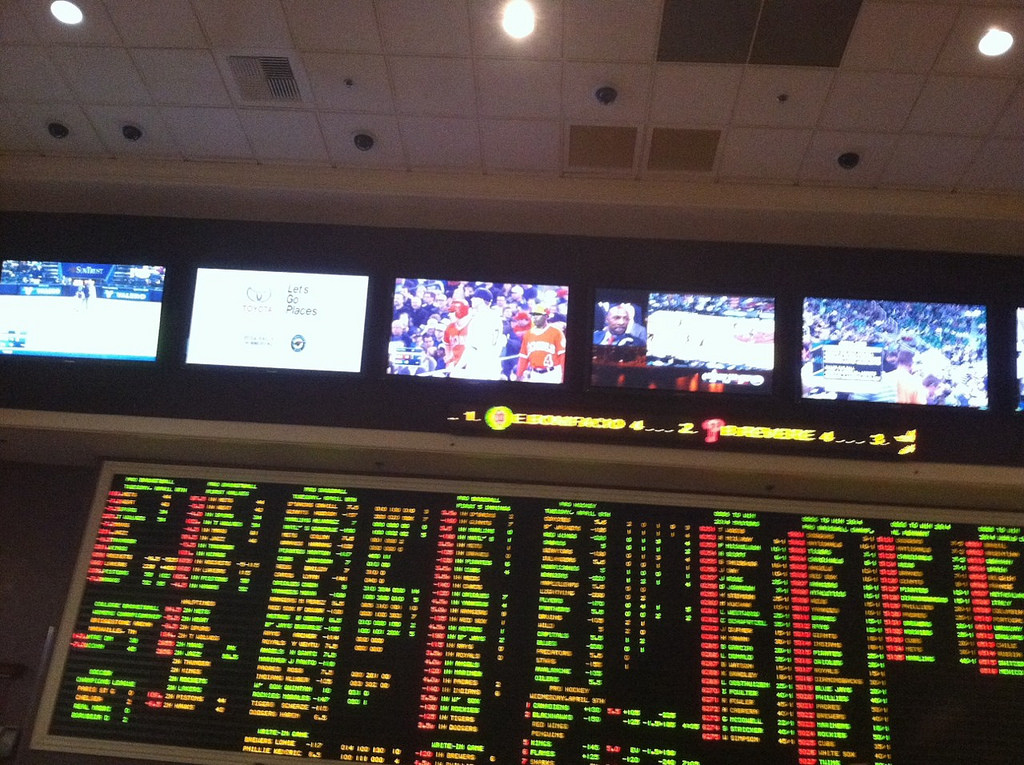 |
| Wikimedia Commons |
That is only one of several examples in which bookmakers
have acted as unofficial partners with the sports leagues. However, Nevada
represents roughly 3%
of the actual betting market in this country. In other words, there stands to
be far more transparency for discovering more examples of point-shaving if
PASPA is overturned, thus improving sports integrity.
The question of how to properly regulate, tax, and ensure
game integrity in an expanded sports betting industry represents uncharted waters
in the United States. Thankfully, the international community provides several
examples with blueprints for the future.
In fact, proper sports integrity regulation is conducted for
only a small fraction of the price demanded by the NBA and that will be detailed
fully in Part II.


